


-
YUNUS EMRE POET AND DERVISH OF TURKISH LITERATURE
Yunus Emre is a Turkish folk poet and thinker who lived in the 13th century. Yunus Emre, who belonged to the Alevi-Bektashi belief system, made important contributions to the spread of Islam in Anatolia and left deep traces on Turkish culture with his works and thoughts. The fact that he expressed his philosophical thoughts and observations about humanity in a simple, understandable language made him a figure who was very popular and respected among the people. His works formed one of the cornerstones of Turkish literature and shaped Turkish cultural life for centuries.
LIFE AND PERIOD
Information about Yunus Emre's life is limited. However, it is accepted that he lived in Anatolia in the 13th century and grew up in a Sufi environment like Mevlana. The fact that he lived in one of the most brilliant periods of Turkish-Islamic culture shaped his poetry. Anatolia was a geography where different cultures and beliefs came together and hosted many civilizations.WORKS AND THEME
Yunus Emre's most well-known work is 'Yunus Emre Divan'. His work played an important role in the acceptance of Turkish as a literary language. In his Divan, there are many poems about the concepts of love, death, nature and God. Although the work has a mystical depth, it is written in a language that the public can understand.LANGUAGE AND STYLISTIC FEATURES OF YUNUS EMRE
Yunus Emre's language and stylistic features are one of the most important reasons for his acceptance as a folk poet. Thanks to his poems written in a simple and understandable language, mystical and deep subjects were easily understood by the public. In this way, he introduced the Turkish people to Islam and Sufism more closely.A HAND REACHING OUT TO THE PEOPLE: YUNUS EMRE'S PLACE TODAY
Yunus Emre's works are not only of historical value, they are also important today. Especially his messages of tolerance, unity and love find a place in the social and cultural structure of modern Türkiye. Especially in recent years, Yunus Emre's works have been transmitted to new generations in many different media formats. His teachings also offer solutions to the cultural and social problems of today's Türkiye.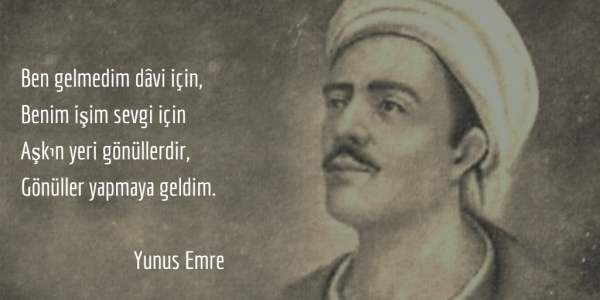


YUNUS EMRE: AN AMBASSADOR OF CULTURE AND FAITH
Yunus Emre is not only a poet but also an ambassador of culture and faith. With his works and philosophy of life, he made significant contributions to Turkish culture and popularized Sufi teachings. Yunus Emre, who is an important part of Anatolia's rich cultural mosaic, has also made significant contributions to the recognition of Turks and Türkiye on the world stage.